
Buying a handset is a purchase, not a note in the drawer
Money leaves the till, a device arrives with no paperwork behind it, and both need to end up somewhere a report can see. This makes the whole thing one record — inspected, approved, paid and on the shelf.
Where a trade-in disappears
Buying stock from the public is the one flow most shop systems simply do not have.
Cash goes out of the drawer and the day's takings never explain it.
A handset is bought at the counter and priced by whoever happened to be on.
The device sits in a drawer for a week before anyone lists it.
Store credit is promised verbally and honoured from memory.
Nobody can say what the shop paid for a handset it is about to sell.
The seller's details were written on a pad that is now full.
Counter to shelf, as a set of states
Each step is a state the record actually holds, so at any moment you can see exactly how far a buy has got.
- 01Take it inThe handset and the seller's detail are captured as a record.
- 02InspectCondition and working order assessed before any money is agreed.
- 03ApproveA manager signs off the price the shop is paying.
- 04PurchaseThe buy is committed at the approved figure.
- 05Pay the sellerCash, bank transfer, store credit or against a sale.
- 06Add to inventoryThe handset becomes a device unit with its own cost and specs.
Because paying the seller is a real money movement, it reaches the cash drawer and the account ledger the same way every other payment does — rather than being an unexplained gap in the day.
One buy, start to finish
The record, and the money it moved.
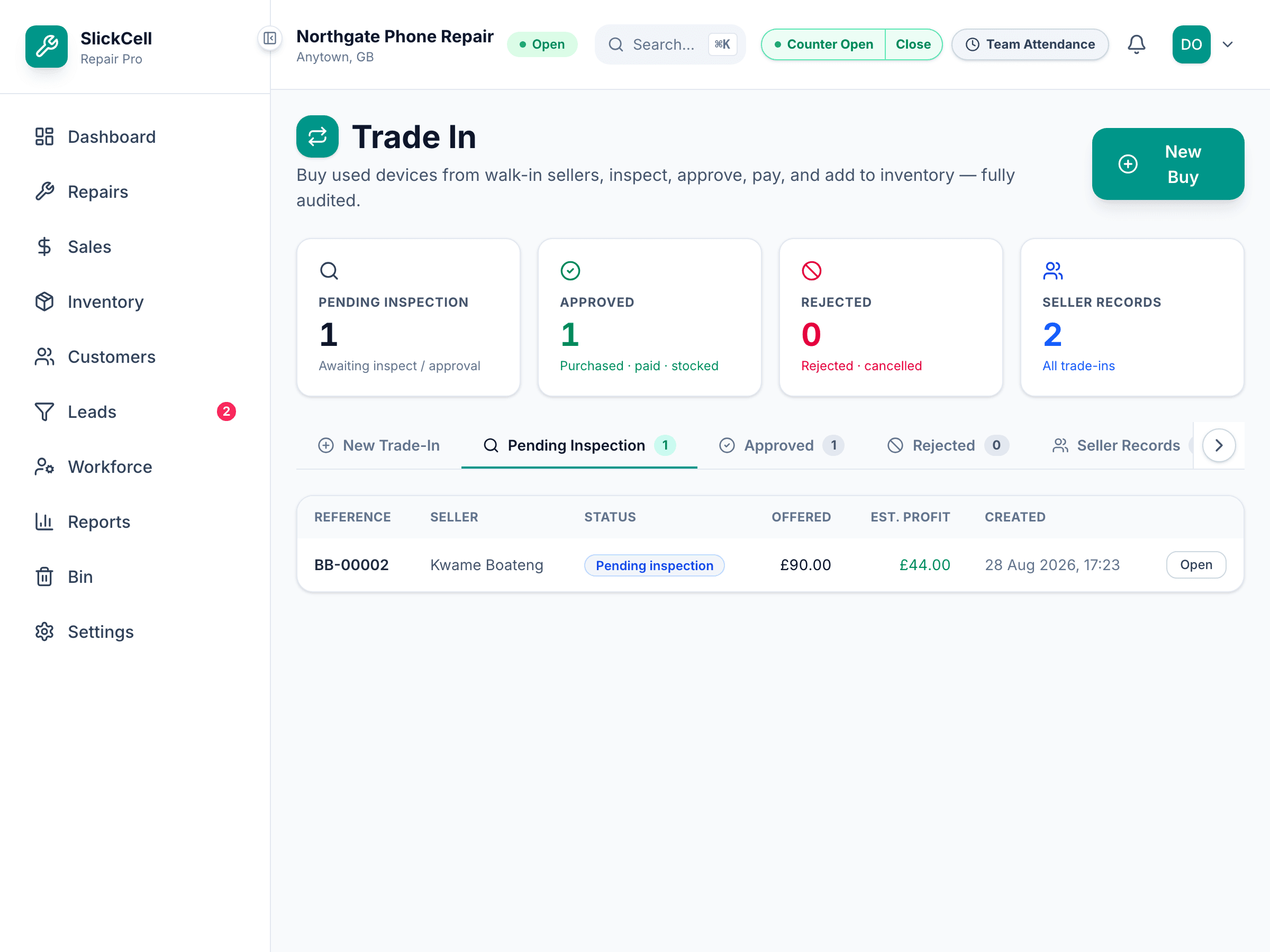
Inspected first, priced second, paid third
A buy waits for inspection and then for a manager's approval before any money is committed. The person on the counter can start the record without being the person who decides what the shop pays for it.
Approval is a state the record has to pass through, not a conversation.
Northgate Device Care
Unit 4, Northgate Retail Park
RECEIPT · INV-00048
23/07/2026, 14:32:00
Bill To:Hannah Vogel
Screen Replacement — iPhone 12
1 × £89.00 · VAT 20% · tax £17.80£89.00Tempered Glass Screen Protector
2 × £7.50 · VAT 20% · tax £3.00£15.00
Payments
- Card · ****4242 · 23/07/2026£100.00
- Cash · 23/07/2026£24.80
Thank you for your business.
Credit you can account for
Settle a trade-in as store credit and it becomes a ledger entry, not a promise. It is applied against a sale as a real payment, so the customer's balance and the shop's books agree about what is owed.
Trade-in credit is its own ledger, applied as a payment when it is used.
Money out of the drawer is money you can explain
- The payout is accounted for
- Paying a seller is a recorded money movement that reaches the drawer, the account ledger and the reports.
- Pricing is a decision, not a habit
- Inspection and approval sit between the handset arriving and the shop paying for it.
- The handset enters stock properly
- It becomes a device unit with the cost you actually paid, so its margin is real when it sells.
- Seller detail is held, and restricted
- The record keeps who you bought from, and that detail is visible only to the roles that should see it.
Every SlickCell feature is included on every plan — plans differ by team size, locations, discounts and support.
The awkward ones, handled
- The handset fails inspection
- The buy is rejected as a recorded outcome. It does not vanish — you can see what was turned away and why.
- The seller changes their mind
- Cancelled is its own state, distinct from rejected. What happened is still on the record.
- They want credit instead of cash
- Store credit is one of the settlement methods, and becomes a ledger entry applied against a future sale.
- They are trading in against something they are buying now
- The trade-in value settles against the sale rather than money going out and coming straight back in.
- The shop paid too much
- The cost stays on the unit, so the thin margin is visible when it sells instead of being averaged away.
- A staff member should not see seller details
- Sensitive seller information is restricted by role, so the counter can take a device in without the whole shop seeing the person's details.
- The device is locked
- PIN, password or a drawn pattern can be recorded against the device, behind a role check and with every reveal audited.
What you are required to record when buying from the public differs by country — the system holds the detail, but check what applies where you trade.
What buyback carries
Inspection before price
Condition is assessed as its own step, before the shop commits to a figure.
Manager approval
The payout figure is signed off by someone with the authority to sign it off.
Four ways to settle
Cash, bank transfer, store credit, or against something they are buying.
Store credit ledger
Credit is a balance that gets applied as a real payment, not a promise.
Straight into unit stock
The handset becomes a device unit carrying the cost you actually paid.
Restricted seller detail
Who you bought from is held on the record and visible only to the right roles.
What shops ask about buying stock in
The volume is not the problem — the untracked cash is. A handful of unexplained payouts a week is exactly the kind of thing that makes a month's cash refuse to reconcile, and it is far harder to unpick later than to record at the counter.
Yes, and that is the intended shape. They create the record and inspect; approval of what the shop pays is a separate state that a manager moves it through.
It is its own ledger. Settling a buy as store credit creates a balance for that customer, and when they spend it, it is applied against the sale as a real payment — so both sides of it appear in the books.
No. There is no blacklist or stolen-device checking in the product. That check, where it applies to you, is still yours to make.
That depends entirely on where you trade, and we are not going to pretend otherwise. The system holds the seller's details, the device, the price and the date against the buy, and restricts who can see them — what your jurisdiction requires you to keep is a question for your own advice.
Yes. Buyback has its own report, the payout appears in the money account as cash going out, and the handset's cost follows it into stock so its margin is right when it sells.
Walk one trade-in through with us
From the handset landing on the counter to it sitting on the shelf as priced stock, with the money accounted for at every step.