
What was in the drawer, what the day says, and the difference between them
Open on a float, close on a count, and see the gap stated rather than absorbed. Then read every pound that moved — in and out — as a statement with a running balance.
How a drawer stops agreeing with anything
Nobody decides to lose track of cash. It happens one unrecorded movement at a time.
The float goes in and nobody writes down how much.
A supplier is paid out of the till and the note goes missing.
A refund is handed over in cash and the day's takings quietly stop matching.
The till is counted, it is £12 out, and £12 is not worth an argument — so nothing is recorded.
A month later the shop is consistently short and there is nothing to look at.
The bank does not match the takings, and nobody can say which of the two is wrong.
A day, from float to close
Each step writes to the same session, so the close has something to be measured against.
- 01OpenRecord the float that is actually in the drawer.
- 02TradeSales, refunds, payouts and manual entries attach to the open session.
- 03CountAt close, count the cash. It is required, not optional.
- 04ReconcileExpected against counted, with the difference shown rather than absorbed.
- 05Bank and cardCount them too, or say you did not — the two are different answers.
- 06CloseThe session is stamped with every expected, actual and difference figure.
- 07Read the ledgerThe day joins a running statement of money in and money out.
The point is the fourth step. A count that cannot disagree with anything is not a count.
Money in, money out, and what is left
Not a profit statement. A statement of cash, which is a different and more immediate question.
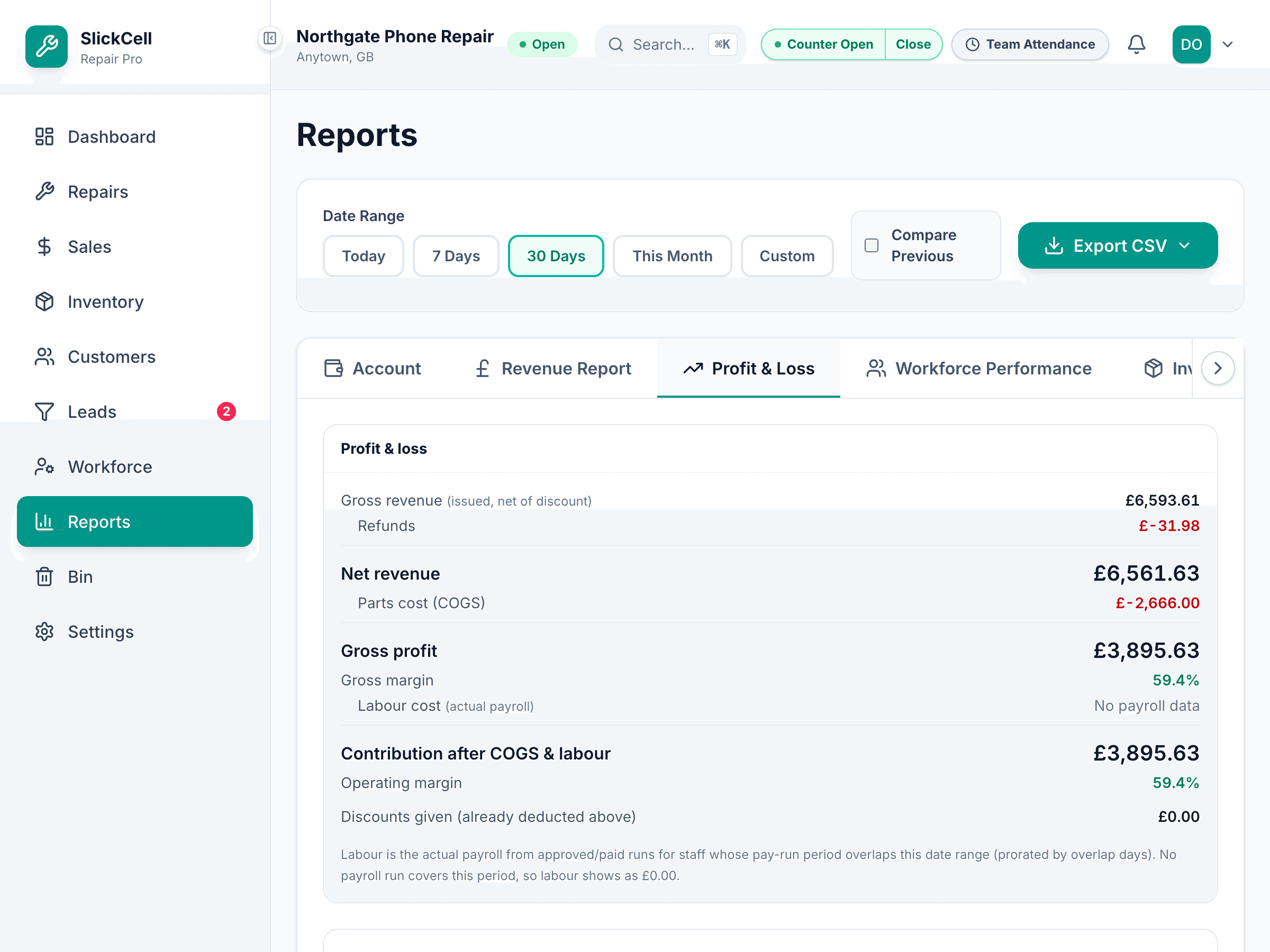
Totals that open onto their records
The reports read from the same ledger the till writes to, and a figure can be opened to see the records underneath it. A number you cannot open is a number you have to trust.
Every figure traces back to the records behind it.
What you can answer at the end of a week
- Whether the drawer is right
- Not roughly. Counted against expected, with the difference kept.
- Where the difference lives
- A shop that is short on Tuesdays is a pattern. It only exists if the small differences were recorded.
- What actually left the business
- Supplier payments, refunds, trade-in payouts and expenses, in one place, in date order.
- Cash against card
- Counted separately, and allowed to be uncounted, because “we did not check the card machine” is a real answer.
- A balance that carries
- Each day opens on the closing position of everything before it, so a period is never read in isolation.
The awkward days
- Somebody took a payment before opening the till
- The movement is still attached to a session — one is opened for it, on a zero float, marked as having been opened automatically. The prompt to open the counter is there to stop that happening; the ledger is built so that when it does, nothing is left unaccounted.
- The count is out by a few pounds
- Record it. The difference is stored with the session rather than rounded away, which is the only reason next month's pattern will exist.
- Nobody checked the card machine
- Leave bank and online uncounted. That is stored as “not counted”, which is a different fact from “counted, and it was zero”.
- A supplier was paid from the drawer
- It reaches the session as a cash movement out, so the expected figure at close already knows about it.
- A refund was given in cash
- Same: the drawer is expected to be lighter, and the ledger shows it as money out rather than as missing revenue.
- Rent, wages or a one-off expense
- Recorded as a manual entry against a category, in or out, with the method it was paid by. Cash entries wait for an open counter like anything else.
- Two people want to close the till
- There is one open session per shop, so there is one close, and it is the one everyone is looking at.
- The accountant needs the figures
- Reading the ledger is open to owners, managers and the accountant role. Writing entries is owners and managers only, enforced by the database rather than by hiding a button.
What cash control carries
Open on a float
One open session per shop, with the starting cash recorded rather than assumed.
Movements attach themselves
Sales, refunds, supplier payments and trade-in payouts join the open session as they happen.
Close on a real count
Counted cash is required. Bank and online can be counted, or explicitly left uncounted.
The difference is kept
Expected, actual and difference are stored for cash, bank and online, and stay on the session.
A bank-statement view
Opening balance, money in, money out and a running balance, newest first, day by day.
Open a day to see it
Each day breaks down into the movements that made it, so a total is never the end of the trail.
Manual money in and out
Rent, wages, an owner top-up, an insurance payout — categorised, dated and attributed.
Read and write are different rights
Owners, managers and accountants can read it. Only owners and managers can write to it.
The questions owners ask about counting the till
Something to count against. A count on its own tells you what is in the drawer; a count against an expected figure tells you whether that is the right amount — and stores the difference, so a recurring shortfall becomes visible instead of being absorbed each night.
No, and it deliberately does not — refusing a customer's cash because of a bookkeeping step would be the wrong trade. You are prompted to open it, and if a cash movement happens anyway a session is opened for it automatically, on a zero float and marked as such. The ledger never ends up with cash that belongs to nothing.
There is no printed close report. Closing produces a record you can open on screen — the expected and counted figures, the difference, the cash movements in that session and its event history.
No, and the difference matters. This follows cash: what came in, what went out, what is left. Issuing an invoice does not appear here because no money moved, and wages only appear if you enter them. Profit is a separate report.
Count bank and card at close and the expected figures are there to compare against, with their own differences recorded. If nobody checked, leave them uncounted — that is stored as a distinct answer rather than as a zero.
Owners, managers and the accountant role can read the ledger. Only owners and managers can add, edit or void an entry, and that is enforced on the server rather than by hiding controls.
Close a day and see where the difference came from
We will run a day on a demo shop — a sale, a cash refund, a supplier paid from the drawer — and close it in front of you.