
Invoices, payments and refunds in one financial history
The problem is rarely the first invoice. It is what happens to it afterwards — the correction, the part refund, the goodwill discount — and whether any of that leaves a trace you can follow in three months.
Where settled money quietly changes
Each of these is a reasonable thing to do at the counter. Together they are why the books stop agreeing with the till.
A paid invoice is edited to fix a line, and last week's takings change with it.
A goodwill reduction is applied by overwriting the total rather than recording it.
A part refund is handed back in cash and noted on a scrap of paper.
Two invoices exist for one job because it was easier than correcting the first.
The report and the invoice list disagree, and nobody can say which is right.
An amount is written off, and six weeks later nobody remembers who agreed it.
Invoice, part payment, adjustment, refund, credit note
The sequence a real job actually takes — and the point at which the rules change.
- 01Invoice raisedGenerated from the job, carrying its lines and totals.
- 02Part paymentRecorded against the invoice; the balance updates.
- 03Still openDraft and unpaid invoices update through the ticket workflow.
- 04Payment recordedFrom here, settled history can no longer be rewritten.
- 05AdjustmentA later change becomes a recorded correction of its own.
- 06Credit or refundMoney owed back is a credit note or a refund, not an edit.
The line in the middle is the whole page. Before a payment, an invoice is a working document. After one, it is financial history — and history gets corrected by adding to it, never by overwriting it.
The document, and the report that reads from it
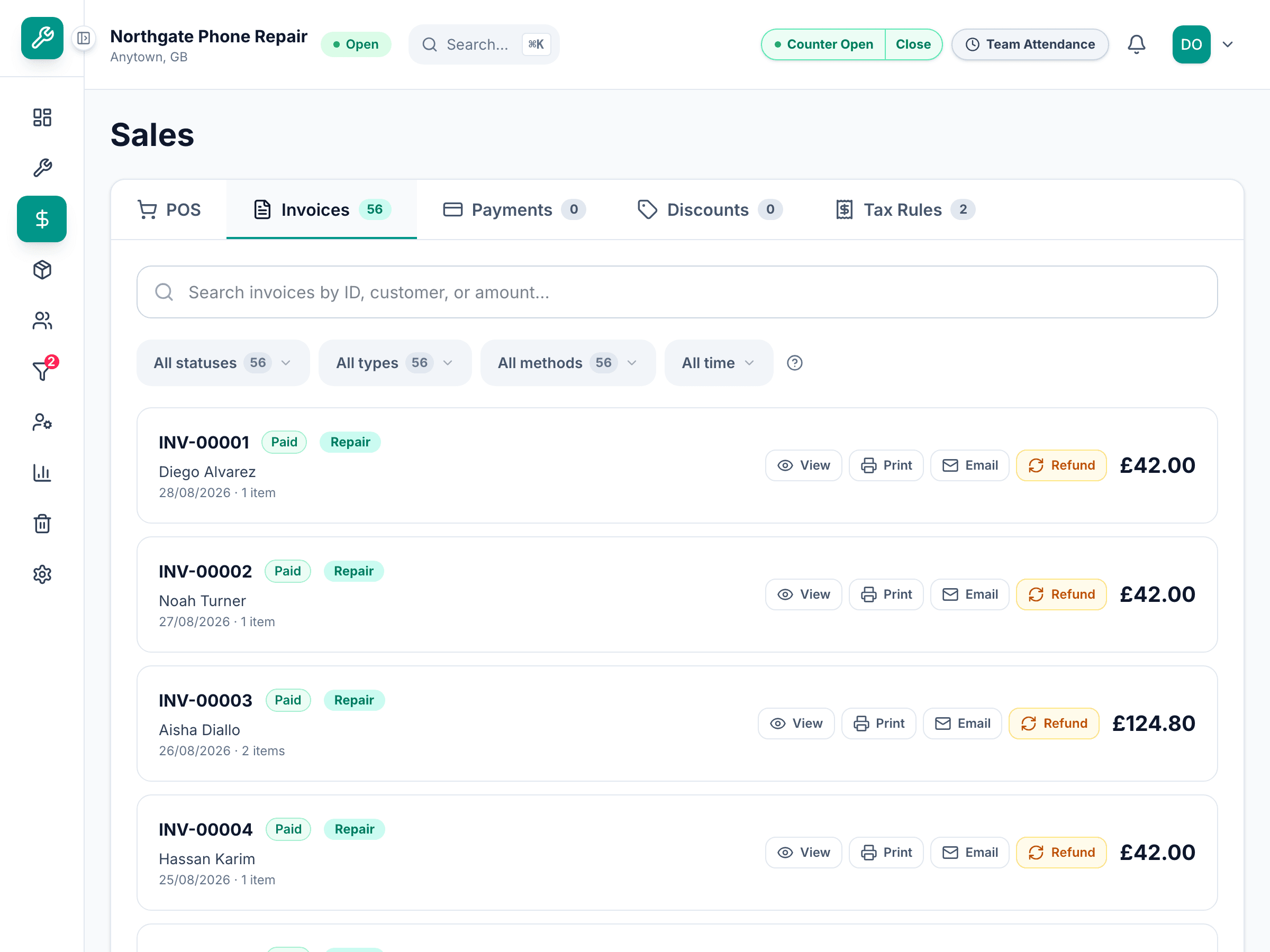
Two artefacts in real markup. The figures in the second are the invoices in the first.
One invoice, every tender against it
The subtotal, the tax, the total, what has been received, what change went back and what is still due — as separate figures on the document itself. A part payment leaves a visible balance rather than a rounded-down total, and each tender line keeps its own method and date.
A settled invoice cannot be reduced silently after payment.
Total Revenue
£593.80
Invoiced (accrual basis) · all channels
4
Completed
£148.45
Per transaction
Today · 23 Jul 2026 · 4 invoices
- INV-00048Repair£124.80View detailsHannah Vogel · paidtax £20.80 · paid £124.80
- INV-00049Sale£54.00View detailsMarcus Adeyemi · paid-£6.00 · tax £9.00 · paid £54.00
- INV-00050Repair£96.00View detailsRachel Okonjo · partially_paidtax £16.00 · paid £60.00
- INV-00051Sale£319.00View detailsTomas Novak · paidtax £14.00 · paid £319.00
-£6.00 · tax £59.80 · paid £557.80
Reports read from the same underlying records
Reports read from the same underlying financial records as the invoices, with reconciliation checks and drill-downs — so a revenue figure opens onto the invoices that compose it, and the rows add up to the headline rather than approximating it.
The report is not a separate number; it is the same number, traced.
What you can prove three months later
Not that nothing ever goes wrong — that everything which did is still legible.
- Corrections are additive
- A change adds a record rather than replacing one, so the original stays readable.
- Payments survive edits
- The payment history is preserved whatever happens to the invoice afterwards.
- Reasons travel with money
- A credit, a refund or a write-off carries why it happened, not just how much.
- One job, one thread
- Related documents stay linked instead of becoming two unrelated invoices.
- Figures you can open
- A total drills down to the records that produced it when someone asks.
What happens when something has to change
Every one of these is a real thing that happens after money has moved. None of them overwrites what was there.
- The invoice is still draft or unpaid
- It can be updated through the approved ticket workflow, because nothing has been settled yet. This is the only window in which the document itself changes.
- A payment has been recorded
- From that point, financial changes cannot silently rewrite settled history. Every correction below adds a record instead of editing the original.
- Work was added after the bill was paid
- The extra becomes a controlled adjustment or an additional invoice. The first invoice keeps the figures it was paid against.
- A line has to come off
- Removing a charge after payment creates a recorded correction, not a deletion. A paid part cannot simply disappear from the job.
- A discount is agreed afterwards
- It is recorded as a correction with its own entry, rather than the total being quietly reduced to match what the customer actually handed over.
- The customer was overcharged
- A credit note records what is owed back, linked to the invoice that caused it, so the correction and the original are readable together.
- Money goes back to the customer
- A refund is recorded as its own movement against the invoice. It reduces what has been settled without pretending the original payment never happened.
- A small balance will never be paid
- It is closed with an approved write-off carrying a reason, rather than being absorbed into a discount that leaves no trace of the decision.
- Somebody asks why the total moved
- The invoice carries its adjustments, credits and refunds as history, so the answer is on the record rather than in whoever happened to be on the counter that day.
Added charges, removals, discounts and corrections must create a controlled adjustment, an additional invoice, a credit note, a refund or an approved write-off — and the original payment history is preserved.
What invoicing carries
Invoice from the job
Generated from the record it belongs to, so the bill and the work cannot disagree.
Part payments
Received, due and change tracked separately, with a visible balance rather than a rounded total.
Adjustments
Post-payment changes recorded as corrections that sit alongside the original.
Credit notes
What is owed back, linked to the invoice that caused it and readable together.
Payment history
Every tender, correction and refund against the invoice, in the order it happened.
No silent rewrites
Once a payment exists, settled history is added to rather than overwritten.
What owners and accountants ask
Including the one that comes up on every call.
Your accountant works from what you give them. If a paid invoice was edited in March, they are reconciling a figure that no longer matches the payment it received. This does not replace an accountant — it means the records handed over are the records that actually happened.
Not directly. Draft and unpaid invoices update through the approved ticket workflow. Once a payment is recorded, added charges, removals, discounts and corrections must create a controlled adjustment, an additional invoice, a credit note, a refund or an approved write-off — and the original payment history is preserved.
The balance stays visible against the invoice. Received, due and change are separate figures, so a shortfall remains something you can chase and settle later rather than being absorbed into the total as though it were a discount.
A credit note records that money is owed back and links to the invoice that caused it. A refund records money actually going back to the customer. Both sit alongside the original rather than modifying it, so the sequence stays readable afterwards.
Yes, as an approved write-off carrying a reason. The balance is closed deliberately and the decision is recorded, rather than the amount quietly becoming a discount that nobody can account for at the year end.
Reports read from the same underlying financial records as the invoices, with reconciliation checks and drill-downs. A revenue figure opens onto the invoices behind it, so where a difference exists you can see which records produced it rather than guessing.
See the payment and refund history
Bring the invoice that had to be corrected after it was paid, and we will walk through what the record looks like afterwards.